
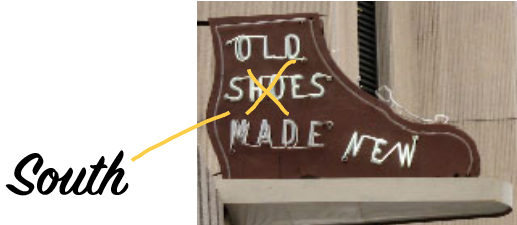
The historically significant boot-shaped sign atop our building dates to the era of opal glass lettering on advertising signs in the early days of electricity but before neon. The opal glass letters were illuminated from inside the sign. An interesting five-minute YouTube video here gives a closer look at how this lettering was made. Researchers of Americana believe that NewSouth’s sign is one of the last surviving examples of such a sign in the shape of an object. Our sign was erected in the early 1900s by the Montgomery Shoe Factory — a glorified name for a shoe repair shop — that occupied the property until the 1980s, after which it sat vacant until NewSouth bought it in 2000.
The chronology of our building is complicated because the original three-story building at the SE corner of Court and Washington streets was at what today would be 101 S. Court Street. Around 1960, the then owners of the Montgomery Shoe Factory demolished a two-story building at 105 S. Court Street and erected a new two-story building and transferred to it the signage from the original building at 101 S. Court. When the Shoe Factory had moved into their new structure at 105 S. Court Street, they then demolished the preexisting three-story building next door. About the same time, urban renewal had brought a branch of the Pizitz department store to downtown, dominating what was ranamed as One Court Square, with a five-level parking deck entered by a spiral ramp opening off the NW corner of Court and Washington, with a new curve in the street that cut off some of the front of the Shoe Factory’s original lot. The original building had fronted right on the sidewalk on the east side of South Court Street; after the change in the street a brick patio and a circular brick planter were added to the front of the lot, and the Shoe Factory constructed another new building — one-story and not as deep, designed by the same architect — which was occupied by the Brenner’s Leather Goods store. The Brenner family owned the Montgomery Shoe Factory. The Brenners would have operated the businesses in both both Coincidentally and also historically interesting, attorney and author Ed George has documented strong evidence that the celebrated African American folk artist Bill Traylor worked in the original Montgomery Shoe Factory in the 1930s and lived near the residence of the Brenners in the downtown neighborhood of Cottage Hill.
When NewSouth bought and occupied 105 South Court in 2000, we kept the original neon/opal glass boot sign atop the building. And in the Montgomery Shoe Factory sign on the front facade of the building, we changed “Shoe” to “Book,” and then we added new panels in another sign to display the NewSouth Books name.